How does data rotation work in Analytics?
Sensedia Analytics uses an automatic data rotation model to ensure performance, storage predictability, and compliance with the contracted retention period.
This model applies to the traces and calls indexes, each with specific rules for data rotation and deletion.
NOTEThe date calculation considers the GMT-0 time zone. For this reason, the daily index to be deleted may contain data from the previous day in local time.
How does traces index rotation work?
The traces index is rotated on a monthly basis.
The deletion criteria always considers the oldest month available in the index.
By default, traces index data is retained for 90 days. When this limit is reached, the following behavior occurs:
- The oldest month is completely removed.
- After deletion, the index contains approximately 60 days of data.
- New data continues to be ingested until the history completes the 90-day retention period again.
How does calls index rotation work?
The calls index is rotated according to the contracted retention period for Analytics.
Data deletion occurs daily and follows this criterion:
- The index corresponding to the oldest day is removed.
Why can I see data from the previous day or month in the index being deleted?
In both the traces and calls indexes, the rotation process uses GMT-0 as the calculation base.
This means that, depending on the local time, the index being removed may contain data from the previous day (in the case of calls) or the previous month (in the case of traces). This behavior is expected and does not indicate inconsistency or failure in the retention process.
Example of calls index rotation
The example below illustrates a scenario with 3-day retention, considering the execution of daily deletion after 00:00 (GMT-0).
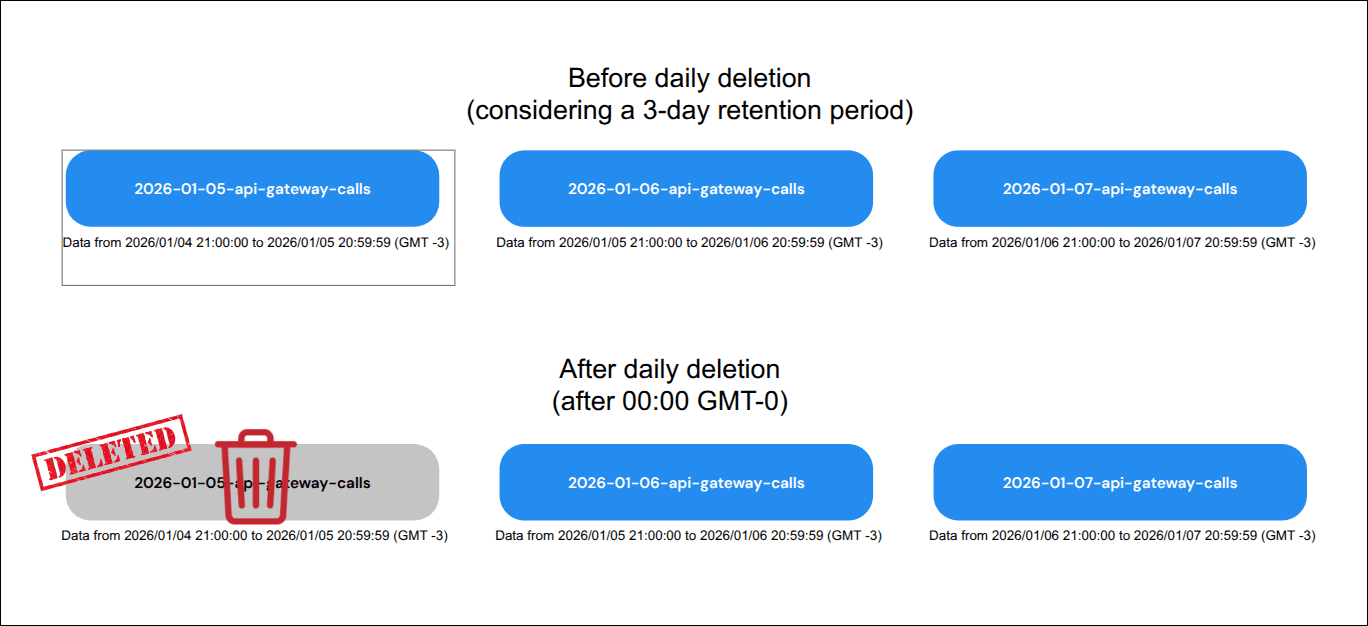
Before the daily deletion, the system maintains the indexes corresponding to the last days within the configured retention period.
After the deletion process is executed, the index for the oldest day is removed, keeping only the most recent days within the retention window.
Does data rotation require any manual action?
No. The rotation process is automatic and occurs continuously, respecting the retention rules configured for each index.
Deletion criteria are based exclusively on date and retention time, ensuring consistency in the data history available in Analytics.